'Had I not been awake'
by Seamus Heaney
Had I not been awake I would have missed it,
A wind that rose and whirled until the roof
Pattered with quick leaves off the sycamore
And got me up, the whole of me a-patter,
Alive and ticking like an electric fence;
Had I not been awake I would have missed it
It came and went so unexpectedly
And almost it seemed dangerously,
Returning like an animal to the house,
A courier blast that there and then
Lapsed ordinary. But not ever
Afterwards. And not now.
Showing posts with label Poem. Show all posts
Showing posts with label Poem. Show all posts
Tuesday, August 11, 2009

Thursday, August 6, 2009
Great Poem: "The Dawn" By Federico Garcia Lorca

It amazes me that this poem was written 80 years ago, and it still has so much insight into the New York of today. It's truly a great poem.
The Dawn
The New York dawn has
four columns of mud
and a hurricane of black doves
that paddle in putrescent waters.
The New York dawn grieves
along the immense stairways,
seeking amidst the groins
spikenards of fine-drawn anguish.
The dawn comes and no one receives it in his mouth,
for there no morn or hope is possible.
Occasionally, coins in furious swarms
perforate and devour abandoned children.
The first to come out understand in their bones
that there will be no paradise nor amours stripped of leaves:
they know they are going to the mud of figures and laws,
to artless games, to fruitless sweat.
The light is buried under chains and noises
in impudent challenge of rootless science.
Through the suburbs sleepless people stagger,
as though just delivered from a shipwreck of blood.
Sunday, August 2, 2009
Great Poem: "Barges on the Hudson" by Babette Deutsch
Barges on the Hudson
Going up the river, or down, their tuneless look
Is of men grown poorer who, though ageing, wear
Some majesty of the commonplace. Old barges
Are cousin to those whom poverty becomes—
To late November, the north, nightfall, all the
Deprived whom increment of loss enlarges.
They have no faces, have no voices, even
Of their own selves no motion. Yet they move.
With what salt grace, with a dim pride of ocean
Uncompassable by a fussy tug,
Prim nurse that drags or nudges the old ones on.
They must borrow their colors from the river, mirror
The river’s muddy silver, in dulled red echo
A sundown that beds in soot. Their freight, rusty,
Faded, cindery, is like the past
The charwoman deals with. Yesterday’s business
They carry with the dignity of the blind.
By night the river is black, they are black’s shadows
Passing. The unwrinkled stars dispute that darkness
Alone with a lantern on a one-eyed spar.
Monday, July 27, 2009
Great Poem: "The Spring Campaigns" by Julio Martinez Mesanza
The Spring Campaigns
Other men remember the false gardens
of love, and the days they were in love
or thought they were in love, and others
the books they read as children, books that marked
their lives forever, though they couldn't know
in those days how the real world operates.
And all of them take comfort in this way
and even grow enthusiastic when
they realize that memory can shape
itself at will and provide the things
that love and books and gardens can't provide.
I remember what I didn't undertake:
more than anything, the spring campaigns.
Friday, July 3, 2009
Great Poem: "1999" by Kevin Gonzalez
It's been awhile... enjoy this poem by Kevin Gonzalez.
1999
by Kevin Gonzalez
We were driving to your funeral
& our father was not crying
because he has a way
of tying ribbons around grief.
It was the year we learned
the piercing that prefaces the blood
holds the most delicate of darknesses.
Then it was the year we opened
all our faucets & waited for the sea
to bleed to death. Then it was the year
we set fire to your mitt. Then, suddenly
the year we started to believe
every thorn was just a bridge.
Then the year all we talked about
was boxing. Then the year
my stomach hurt all year, & then
the year no one spoke of you.
If there were an antonym for suicide
we could all choose when to be born.
I would have been born after that day
so I could not remember you.
So my fingers would stop pointing
at all the things that aren't there.
1999
by Kevin Gonzalez
We were driving to your funeral
& our father was not crying
because he has a way
of tying ribbons around grief.
It was the year we learned
the piercing that prefaces the blood
holds the most delicate of darknesses.
Then it was the year we opened
all our faucets & waited for the sea
to bleed to death. Then it was the year
we set fire to your mitt. Then, suddenly
the year we started to believe
every thorn was just a bridge.
Then the year all we talked about
was boxing. Then the year
my stomach hurt all year, & then
the year no one spoke of you.
If there were an antonym for suicide
we could all choose when to be born.
I would have been born after that day
so I could not remember you.
So my fingers would stop pointing
at all the things that aren't there.
Tuesday, May 19, 2009
Great Poem: William Carlos William's "A Love Song"
Another beauty by WCW.
A Love Song
By William Carlos Williams
What have I to say to you
When we shall meet?
Yet—
I lie here thinking of you.
The stain of love
Is upon the world.
Yellow, yellow, yellow,
It eats into the leaves,
Smears with saffron
The horned branches that lean
Heavily
Against a smooth purple sky.
There is no light—
Only a honey-thick stain
That drips from leaf to leaf
And limb to limb
Spoiling the colours
Of the whole world.
I am alone.
The weight of love
Has buoyed me up
Till my head
Knocks against the sky.
See me!
My hair is dripping with nectar—
Starlings carry it
On their black wings.
See, at last
My arms and my hands
Are lying idle.
How can I tell
If I shall ever love you again
As I do now?
A Love Song
By William Carlos Williams
What have I to say to you
When we shall meet?
Yet—
I lie here thinking of you.
The stain of love
Is upon the world.
Yellow, yellow, yellow,
It eats into the leaves,
Smears with saffron
The horned branches that lean
Heavily
Against a smooth purple sky.
There is no light—
Only a honey-thick stain
That drips from leaf to leaf
And limb to limb
Spoiling the colours
Of the whole world.
I am alone.
The weight of love
Has buoyed me up
Till my head
Knocks against the sky.
See me!
My hair is dripping with nectar—
Starlings carry it
On their black wings.
See, at last
My arms and my hands
Are lying idle.
How can I tell
If I shall ever love you again
As I do now?
Wednesday, May 13, 2009
Great Poem: Ezra Pound's "The River-Merchant's Wife: A Letter"
I can't believe I've never read this one, but it's something else. Enjoy.
The River-Merchant's Wife
By Ezra Pound
While my hair was still cut straight across my forehead
I played about the front gate, pulling flowers.
You came by on bamboo stilts, playing horse,
You walked about my seat, playing with blue plums.
And we went on living in the village of Chokan:
Two small people, without dislike or suspicion.
At fourteen I married My Lord you.
I never laughed, being bashful.
Lowering my head, I looked at the wall.
Called to, a thousand times, I never looked back.
At fifteen I stopped scowling,
I desired my dust to be mingled with yours
Forever and forever and forever.
Why should I climb the look out?
At sixteen you departed,
You went into far Ku-to-en, by the river of swirling eddies,
And you have been gone five months.
The monkeys make sorrowful noise overhead.
You dragged your feet when you went out.
By the gate now, the moss is grown, the different mosses,
Too deep to clear them away!
The leaves fall early this autumn, in wind.
The paired butterflies are already yellow with August
Over the grass in the West garden;
They hurt me. I grow older.
If you are coming down through the narrows of the river Kiang,
Please let me know beforehand,
And I will come out to meet you
As far as Cho-fu-Sa.
The River-Merchant's Wife
By Ezra Pound
While my hair was still cut straight across my forehead
I played about the front gate, pulling flowers.
You came by on bamboo stilts, playing horse,
You walked about my seat, playing with blue plums.
And we went on living in the village of Chokan:
Two small people, without dislike or suspicion.
At fourteen I married My Lord you.
I never laughed, being bashful.
Lowering my head, I looked at the wall.
Called to, a thousand times, I never looked back.
At fifteen I stopped scowling,
I desired my dust to be mingled with yours
Forever and forever and forever.
Why should I climb the look out?
At sixteen you departed,
You went into far Ku-to-en, by the river of swirling eddies,
And you have been gone five months.
The monkeys make sorrowful noise overhead.
You dragged your feet when you went out.
By the gate now, the moss is grown, the different mosses,
Too deep to clear them away!
The leaves fall early this autumn, in wind.
The paired butterflies are already yellow with August
Over the grass in the West garden;
They hurt me. I grow older.
If you are coming down through the narrows of the river Kiang,
Please let me know beforehand,
And I will come out to meet you
As far as Cho-fu-Sa.
Monday, May 11, 2009
Great Poem: Michael Blumenthal's "And Here You Are"
When I was an undergrad, Michael Blumenthal was teaching poetry writing. Unfortunately, I never got to take him. It's a shame, he's a wonderful poet. Just check this out.
And Here You Are
By Michael Blumenthal
It's such a relief to see the woman you love walk out the door
some nights, for it's ten o'clock and you need your eight hours
of sleep, and one glass of wine has been more than enough
and, as for lust—well, you can live without it most days and you
are glad, too, that the Ukrainian masseuse you see every Wednesday
is not in love with you, and has no plans to be, for it's the pain
in your back you need relief from most, not that ambiguous itch,
and the wild successes of your peers no longer bother you
nor do your unresolved religious cravings nor the general injustice
of the world, no, there is very little that bothers you these days when
you turn, first, to the obituaries, second to the stock market, then,
after a long pause, to the book review, you are becoming a good citizen,
you do your morning exercises, count your accumulated blessings,
thank the Lord there's a trolley just outside your door your girlfriend
can take back home to her own bed and here you are it is morning you
are alone every little heartbeat is yours to cherish the future is on fire
with nothing but its own kindling and whatever it is that's burning
in its flames isn't you and now you will take a shower and this is it.
Great Poem: Billy Collins's "Marginalia"
I'm not always the biggest Billy Collins fan but this poem's wit made me laugh. Favorite line: "And if you have managed to graduate from college/without ever having written "Man vs. Nature"/in a margin, perhaps now/is the time to take one step forward."
| ||
|
Thursday, May 7, 2009
Great Poem: William Carlos Williams "To a Poor Old Woman"
And here is my favorite William Carlos Williams poem...
| To a Poor Old Woman | ||
| by William Carlos Williams | ||
munching a plum on | ||
Tuesday, May 5, 2009
Great Poem: C.P. Cavary's "Since Nine--"
I kind of dig this poem...curious what people think.
Since Nine—
by C. P. Cavafy
Translated by Daniel Mendelsohn
Half past twelve. The time has quickly passed
since nine o'clock when I first turned up the lamp
and sat down here. I've been sitting without reading,
without speaking. With whom should I speak,
so utterly alone within this house?
The apparition of my youthful body,
since nine o'clock when I first turned up the lamp,
has come and found me and reminded me
of shuttered perfumed rooms
and of pleasure spent—what wanton pleasure!
And it also brought before my eyes
streets made unrecognizable by time,
bustling city centres that are no more
and theatres and cafés that existed long ago.
The apparition of my youthful body
came and also brought me cause for pain:
deaths in the family; separations;
the feelings of my loved ones, the feelings of
those long dead which I so little valued.
Half past twelve. How the time has passed.
Half past twelve. How the years have passed.
Since Nine—
by C. P. Cavafy
Translated by Daniel Mendelsohn
Half past twelve. The time has quickly passed
since nine o'clock when I first turned up the lamp
and sat down here. I've been sitting without reading,
without speaking. With whom should I speak,
so utterly alone within this house?
The apparition of my youthful body,
since nine o'clock when I first turned up the lamp,
has come and found me and reminded me
of shuttered perfumed rooms
and of pleasure spent—what wanton pleasure!
And it also brought before my eyes
streets made unrecognizable by time,
bustling city centres that are no more
and theatres and cafés that existed long ago.
The apparition of my youthful body
came and also brought me cause for pain:
deaths in the family; separations;
the feelings of my loved ones, the feelings of
those long dead which I so little valued.
Half past twelve. How the time has passed.
Half past twelve. How the years have passed.
Saturday, May 2, 2009
Great Poem: William Carlos William's "The Red Wheelbarrow"
 Slowly but surely this is turning into a poetry blog, it seems. But it's probably what I love most in this world, so I think it will continue to be a poetry blog with a few random links here and there.
Anyway, here's another WCW classic. As I said about another WCW poem, I did not understand the brilliance of this poem until I aged. But now I realize that WCW challenges us to do through the use of line breaks and rhythm is to savor each image. He wants to look at each image in the poem and movement of the poem and appreciate it just for the language and nothing else. So try reading it aloud and slowly. Savor each syllable and and be in the moment with it.
The Red Wheelbarrow
By William Carlos Williams
so much depends
upon
upon
a red wheel
barrow
glazed with rain
water
beside the white
chickens.
Thursday, April 30, 2009
Great Poem: Richard Jackson's "Cause and Effect"
I found this on poems.com. Now this is the type of poetry I want to write.
Cause and Effect
by Richard Jackson
It's because the earth continues to wobble on its axis
that we continue to stumble down the streets of the heart.
It's because of the loneliness of the first cell trying to swim
through its primordial pool that we are filled with a kind of
galactic fear. For example: one moment a rocket falls
capriciously into a square. Another moment, a rogue wave
turns over the fishing boat whose crew leaves their memories
floating like an oil slick that never reaches shore.
In this way we understand our dying loves scratching at the door.
In this way, each love creates its own theory of pain. Each love
gnaws the derelict hours to the bone. But because there are
so many blank spaces in history we still have time
to write our own story. Wittgenstein said our words have
replaced our emotions. He never understood how
we have to cleanse ourselves of these invisible parasites
of doubt and fear. We might as well worry about
the signals from dead worlds wandering around the universe
forever. Think instead of how the trees prop up the sky.
How the rain falls into the open eyes of the pond
bringing a vision no one expected. Here's mine: this bee
hovering over the pencil seems to bring a message from
the deepest flowers you inhabit. Because I don't know
where all this love has come from, because the clouds are
covered with our footsteps that know no time, I am
no longer surprised when each day comes from a new place,
because in this way, I can imagine these words getting lost
in your lungs, my fingers curling inside you as if I could
gather you inside my own heart, or tracing the slope of your hip
towards a whole other world. Don't worry. Like us the planet
wobbles because of the shifting hot and cold zones, high
and low pressures, the pull of tides. The stars that are
these words are always closer than we think despite
the theories of astronomers. In this way, I will always be there,
a rain falling into the sea, the abandoned light opening your eyes
despite the curtains of reason, the life you give each time
you turn to me, because the stumbling breaths we borrow
from each other are all we have to keep each other alive.
Cause and Effect
by Richard Jackson
It's because the earth continues to wobble on its axis
that we continue to stumble down the streets of the heart.
It's because of the loneliness of the first cell trying to swim
through its primordial pool that we are filled with a kind of
galactic fear. For example: one moment a rocket falls
capriciously into a square. Another moment, a rogue wave
turns over the fishing boat whose crew leaves their memories
floating like an oil slick that never reaches shore.
In this way we understand our dying loves scratching at the door.
In this way, each love creates its own theory of pain. Each love
gnaws the derelict hours to the bone. But because there are
so many blank spaces in history we still have time
to write our own story. Wittgenstein said our words have
replaced our emotions. He never understood how
we have to cleanse ourselves of these invisible parasites
of doubt and fear. We might as well worry about
the signals from dead worlds wandering around the universe
forever. Think instead of how the trees prop up the sky.
How the rain falls into the open eyes of the pond
bringing a vision no one expected. Here's mine: this bee
hovering over the pencil seems to bring a message from
the deepest flowers you inhabit. Because I don't know
where all this love has come from, because the clouds are
covered with our footsteps that know no time, I am
no longer surprised when each day comes from a new place,
because in this way, I can imagine these words getting lost
in your lungs, my fingers curling inside you as if I could
gather you inside my own heart, or tracing the slope of your hip
towards a whole other world. Don't worry. Like us the planet
wobbles because of the shifting hot and cold zones, high
and low pressures, the pull of tides. The stars that are
these words are always closer than we think despite
the theories of astronomers. In this way, I will always be there,
a rain falling into the sea, the abandoned light opening your eyes
despite the curtains of reason, the life you give each time
you turn to me, because the stumbling breaths we borrow
from each other are all we have to keep each other alive.
Tuesday, April 28, 2009
Great Poem: Jim Harrison's "Age Sixty-Nine"
Just found this poem. What a great finish it has.
Age Sixty-nine
By Jim Harrison
I keep waiting without knowing
what I'm waiting for.
I saw the setting moon at dawn
roll over the mountain
and perhaps into the dragon's mouth
until tomorrow evening.
There is this circle I walk
that I have learned to love.
I hope one day to be a spiral
but to the birds I'm a circle.
A thousand Spaniards died looking
for gold in a swamp when it was
in the mountains in clear sight beyond.
Here, though, on local earth my heart
is at rest as a groundling, letting
my mind take flight as it will,
no longer waiting for good or bad news.
Often, lately, the night is a cold maw
and stars the scattered white teeth of the gods,
which spare none of us. At dawn I have birds,
clearly divine messengers that I don't understand
yet day by day feel the grace of their intentions.
Age Sixty-nine
By Jim Harrison
I keep waiting without knowing
what I'm waiting for.
I saw the setting moon at dawn
roll over the mountain
and perhaps into the dragon's mouth
until tomorrow evening.
There is this circle I walk
that I have learned to love.
I hope one day to be a spiral
but to the birds I'm a circle.
A thousand Spaniards died looking
for gold in a swamp when it was
in the mountains in clear sight beyond.
Here, though, on local earth my heart
is at rest as a groundling, letting
my mind take flight as it will,
no longer waiting for good or bad news.
Often, lately, the night is a cold maw
and stars the scattered white teeth of the gods,
which spare none of us. At dawn I have birds,
clearly divine messengers that I don't understand
yet day by day feel the grace of their intentions.
Friday, April 24, 2009
Great Poem: W.H. Auden's "Musee des Beaux Arts"
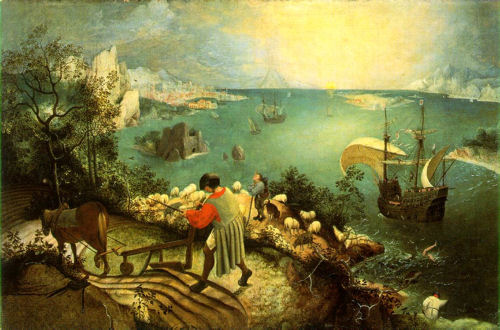
I just discovered this poem, and what a poem it is. It's an ekphrastic poem based on Auden's experience of seeing "Fall of Icarus" by Bruegel for the first time. It speaks to the apathy of humans in the face of individual tragedy, how what we feel as individuals is often not understood or ignored by the world around us. Pain is a solitary burden and something we must all deal with alone. It is something all the great poets understood.
Musee des Beaux Arts
by W.H. Auden
About suffering they were never wrong,
The Old Masters; how well, they understood
Its human position; how it takes place
While someone else is eating or opening a window or just walking dully along;
How, when the aged are reverently, passionately waiting
For the miraculous birth, there always must be
Children who did not specially want it to happen, skating
On a pond at the edge of the wood:
They never forgot
That even the dreadful martyrdom must run its course
Anyhow in a corner, some untidy spot
Where the dogs go on with their doggy life and the torturer's horse
Scratches its innocent behind on a tree.
In Breughel's Icarus, for instance: how everything turns away
Quite leisurely from the disaster; the ploughman may
Have heard the splash, the forsaken cry,
But for him it was not an important failure; the sun shone
As it had to on the white legs disappearing into the green
Water; and the expensive delicate ship that must have seen
Something amazing, a boy falling out of the sky,
had somewhere to get to and sailed calmly on.
The Old Masters; how well, they understood
Its human position; how it takes place
While someone else is eating or opening a window or just walking dully along;
How, when the aged are reverently, passionately waiting
For the miraculous birth, there always must be
Children who did not specially want it to happen, skating
On a pond at the edge of the wood:
They never forgot
That even the dreadful martyrdom must run its course
Anyhow in a corner, some untidy spot
Where the dogs go on with their doggy life and the torturer's horse
Scratches its innocent behind on a tree.
In Breughel's Icarus, for instance: how everything turns away
Quite leisurely from the disaster; the ploughman may
Have heard the splash, the forsaken cry,
But for him it was not an important failure; the sun shone
As it had to on the white legs disappearing into the green
Water; and the expensive delicate ship that must have seen
Something amazing, a boy falling out of the sky,
had somewhere to get to and sailed calmly on.
Saturday, April 18, 2009
Great Poem: Ranier Marie Rilke's "Autumn Day"
I know it's spring, but something made me think of this poem today. Beautiful.
| ||
|
Saturday, April 4, 2009
Great Poem: "The Long Boat" by Stanley Kunitz
I love this poem. There are many ways, I'm sure it can be interpreted, but I like to think of it as sort of a Buddhist poem. It's that feeling of when you let go of everything that is supposed to be you-- ambition, personality or whatever-- you can finally feel some peace.
The Long Boat
By Stanley Kunitz
When his boat snapped loose
from its mooring, under
the screaking of the gulls,
he tried at first to wave
to his dear ones on shore,
but in the rolling fog
they had already lost their faces.
Too tired even to choose
between jumping and calling,
somehow he felt absolved and free
of his burdens, those mottoes
stamped on his name-tag:
conscience, ambition, and all
that caring.
He was content to lie down
with the family ghost
sin the slop of his cradle,
buffeted by the storm,
endlessly drifting.
Peace! Peace!
To be rocked by the Infinite!
As if it didn't matter
which way was home;
as if he didn't know
he loved the earth so much
he wanted to stay forever.
The Long Boat
By Stanley Kunitz
When his boat snapped loose
from its mooring, under
the screaking of the gulls,
he tried at first to wave
to his dear ones on shore,
but in the rolling fog
they had already lost their faces.
Too tired even to choose
between jumping and calling,
somehow he felt absolved and free
of his burdens, those mottoes
stamped on his name-tag:
conscience, ambition, and all
that caring.
He was content to lie down
with the family ghost
sin the slop of his cradle,
buffeted by the storm,
endlessly drifting.
Peace! Peace!
To be rocked by the Infinite!
As if it didn't matter
which way was home;
as if he didn't know
he loved the earth so much
he wanted to stay forever.
Tuesday, March 10, 2009
Great Poem: Stanley Kunitz's "Touch Me"
 I just discovered this poem this morning. In an age were irony rules the day and sincerity is lost in the shuffle, it's wonderful for me to see a work of art were this direct & simple but beautiful and truthful. Amen for Stanley Kunitz.
Touch Me
By Stanley Kunitz
Summer is late, my heart.
Words plucked out of the air
some forty years ago
when I was wild with love
and torn almost in two
scatter like leaves this night
of whistling wind and rain.
It is my heart that's late,
it is my song that's flown.
Outdoors all afternoon
under a gunmetal sky
staking my garden down,
I kneeled to the crickets trilling
underfoot as if about
to burst from their crusty shells;
and like a child again
marveled to hear so clear
and brave a music pour
from such a small machine.
What makes the engine go?
Desire, desire, desire.
The longing for the dance
stirs in the buried life.
One season only,
and it's done.
So let the battered old willow
thrash against the windowpanes
and the house timbers creak.
Darling, do you remember
the man you married? Touch me,
remind me who I am.
Saturday, March 7, 2009
Great Poem: "A Song On the End of the World" by Czeslaw Milosz

Just discovered this poem. Milosz has such a command of simple images interchanged with grand themes that never seem self-conscious, but real, humble and true. Amazing stuff.
| A Song On the End of the World | | |
| by Czeslaw Milosz Translated by Anthony Milosz | ||
| On the day the world ends On the day the world ends And those who expected lightning and thunder Only a white-haired old man, who would be a prophet | ||
Monday, February 9, 2009
Great Poem: Craig Raine's "a Martian Sends a Postcard Home"

I just discovered this poem, and it took me about three readings before I understand everything that was going on. A riddle poem is always nice to read because of the challenge. Toughest line to figure out? "Only the young are allowed to suffer openly. Adults go to a punishment room with water but nothing to eat." It took me a bit, but I'm fairly certain I got it. Be curious to hear what you think.
A Martian Sends a Postcard Home
by Craig Raine
Caxtons are mechanical birds with many wings
and some are treasured for their markings --
they cause the eyes to melt
or the body to shriek without pain.
I have never seen one fly, but
sometimes they perch on the hand.
Mist is when the sky is tired of flight
and rests its soft machine on ground:
then the world is dim and bookish
like engravings under tissue paper.
Rain is when the earth is television.
It has the property of making colours darker.
Model T is a room with the lock inside --
a key is turned to free the world
for movement, so quick there is a film
to watch for anything missed.
But time is tied to the wrist
or kept in a box, ticking with impatience.
In homes, a haunted apparatus sleeps,
that snores when you pick it up.
If the ghost cries, they carry it
to their lips and soothe it to sleep
with sounds. And yet they wake it up
deliberately, by tickling with a finger.
Only the young are allowed to suffer
openly. Adults go to a punishment room
with water but nothing to eat.
They lock the door and suffer the noises
alone. No one is exempt
and everyone's pain has a different smell.
At night when all the colours die,
they hide in pairs
and read about themselves --
in colour, with their eyelids shut.
Subscribe to:
Posts (Atom)

 Posts
Posts

