In his first 100 days in office, Barack Obama has updated his Twitter account only twice. I voted for the guy, but I can’t stand by while President 2.0 throws away the
online cred he built during last year’s campaign.
Two weeks ago, the daytime-TV host Oprah Winfrey and the second-tier celebrity Ashton Kutcher drew national attention — Ms. Winfrey for using Twitter on her show, Mr. Kutcher for collecting a million followers at twitter.com. No one seems to have noticed the president has racked up a million followers without even trying. Imagine if he posted something!
The standard excuse made by Obama apologists — “he’s too busy” — is at best naïve. More often, it’s dishonest. The president records a five-minute video every week. Anyone who’s done video knows a five-minute clip takes a lot more than five minutes of preparation, shooting, and reshooting. A few days ago, Oprah figured out Twitter live on camera in less time than it takes Mr. Obama to explain PAYGO in this week’s address.
Friday, May 1, 2009
Why President Obama needs to tweet more often
Monday, March 23, 2009
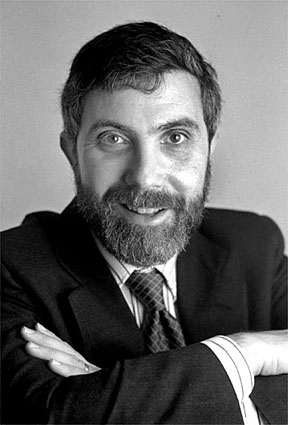
Paul Krugman keeps ripping the Obama administration's financial policies
But the Obama administration, like the Bush administration, apparently wants an easier way out. The common element to the Paulson and Geithner plans is the insistence that the bad assets on banks’ books are really worth much, much more than anyone is currently willing to pay for them. In fact, their true value is so high that if they were properly priced, banks wouldn’t be in trouble.
And so the plan is to use taxpayer funds to drive the prices of bad assets up to “fair” levels. Mr. Paulson proposed having the government buy the assets directly. Mr. Geithner instead proposes a complicated scheme in which the government lends money to private investors, who then use the money to buy the stuff. The idea, says Mr. Obama’s top economic adviser, is to use “the expertise of the market” to set the value of toxic assets.
But the Geithner scheme would offer a one-way bet: if asset values go up, the investors profit, but if they go down, the investors can walk away from their debt. So this isn’t really about letting markets work. It’s just an indirect, disguised way to subsidize purchases of bad assets.The likely cost to taxpayers aside, there’s something strange going on here. By my count, this is the third time Obama administration officials have floated a scheme that is essentially a rehash of the Paulson plan, each time adding a new set of bells and whistles and claiming that they’re doing something completely different. This is starting to look obsessive.
But the real problem with this plan is that it won’t work. Yes, troubled assets may be somewhat undervalued. But the fact is that financial executives literally bet their banks on the belief that there was no housing bubble, and the related belief that unprecedented levels of household debt were no problem. They lost that bet. And no amount of financial hocus-pocus — for that is what the Geithner plan amounts to — will change that fact.
You might say, why not try the plan and see what happens? One answer is that time is wasting: every month that we fail to come to grips with the economic crisis another 600,000 jobs are lost.Even more important, however, is the way Mr. Obama is squandering his credibility. If this plan fails — as it almost surely will — it’s unlikely that he’ll be able to persuade Congress to come up with more funds to do what he should have done in the first
place.
All is not lost: the public wants Mr. Obama to succeed, which means that he can still rescue his bank rescue plan. But time is running out.
Wednesday, March 4, 2009
Socialism and Obama
It seems that "socialist" has supplanted "liberal" as the go-to slur among much of a conservative world confronting a one-two-three punch of bank bailouts, budget blowouts and stimulus bills. Right-leaning bloggers and talk radio hosts are wearing out the brickbat. Senate and House Republicans have been tripping over their podiums to invoke it. The S-bomb has become as surefire a red-meat line at conservative gatherings as "Clinton" was in the 1990s and "Pelosi" is today.
"Earlier this week, we heard the world's best salesman of socialism address the nation," Senator Jim DeMint, Republican of South Carolina, said on Friday, referring, naturally, to a certain socialist in chief.
Former Gov. Mike Huckabee of Arkansas decried the creation of "socialist republics" in the United States. "Lenin and Stalin would love this stuff," Mr. Huckabee said, speaking at the Conservative Political Action Conference here over the weekend, a kind of Woodstock for young conservatives.
"Socialism is something new for us to hit Obama over the head with," said Joshua Bolin of Augusta, Ga., who founded a Web site, "Reagan.org," which he calls a conservative analog to the liberal MoveOn.org.
Thursday, February 26, 2009
Barack Obama is the antichrist and/or Hitler
Tuesday, February 24, 2009
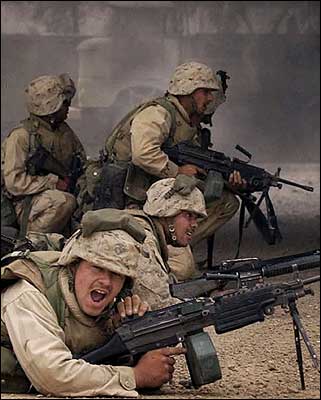
U.S. Troops out of Iraq by 2010
My boy looks like he's going to fulfill this promise:
WASHINGTON — President Barack Obama plans to order that all U.S. combat troops be withdrawn from Iraq by August 2010, administration officials said Tuesday, ending the war that defined his upstart presidential campaign three months later than he had promised.
Obama's plan would pull out all combat troops 19 months after his inauguration, although he had promised repeatedly during the 2008 campaign that he would withdraw them 16 months after taking office. That schedule, based on removing roughly one brigade a month, was predicated on commanders determining that it would not endanger U.S. troops left behind or Iraq's fragile security.
Pledging to end the war in 16 months helped to build enormous grass-roots support for Obama's White House bid.
Monday, February 9, 2009
Obama still popular as fuck
CNN, shows that President Obama is viewed very positively in the legislative battles over the stimulus bill, while the Republican Party remains the unpopular player in this game
Obama has a 76% overall job approval and 23% disapproval. On the economy specifically, his rating is 72%-28%. Meanwhile, Congress has a very poor rating of 29%-71% -- but it quickly becomes clear that this should be not be simply laid at the feet of the majority Democrats, and is instead the GOP's fault.
The Democratic leadership in Congress has a solid rating of 60%-39%, while the Republican leaders are at 44%-55%. Furthermore, respondents said by 74%-25% that Obama is doing enough to cooperate with Republicans, while they say by a 60%-39% margin that Republicans are not doing enough to cooperate with him.
Friday, February 6, 2009
Paul Krugman's "On The Edge"
What they don't understand or don't seem to care is that the general theory of Keynesian economics advocates deficit spending during economic downturns to help create jobs and maintain employment. Sure, there is some waste in this stimulus bill. But most of the programs and money allocated in the bill are going to organizations with the express interest of creating more jobs.
Also, this Republican stance against hypocritical to me. We just went through 8 years of the largest increase in government size in the history of our nation and almost every Republican was behind the president on that, despite the many flaws in the Bush's White House thinking. Yet when a plan, created by many of the best economists today, to help a failing economy comes out, all they can do is rip it. Plus, I think after 8 years of Bush tax cuts and the state of our economy now, it's pretty obvious that tax cuts are not the only solution to fixing the economy. It stinks, I tells you.
Anyway, I've said my two cents. Here's Krugman:
A not-so-funny thing happened on the way to economic recovery. Over the last two weeks, what should have been a deadly serious debate about how to save an economy in desperate straits turned, instead, into hackneyed political theater, with Republicans spouting all the old clichés about wasteful government spending and the wonders of tax cuts.
It’s as if the dismal economic failure of the last eight years never happened — yet Democrats have, incredibly, been on the defensive. Even if a major stimulus bill does pass the Senate, there’s a real risk that important parts of the original plan, especially aid to state and local governments, will have been emasculated.Somehow, Washington has lost any sense of what’s at stake — of the reality that we may well be falling into an economic abyss, and that if we do, it will be very hard to get out again.
It’s hard to exaggerate how much economic trouble we’re in. The crisis began with housing, but the implosion of the Bush-era housing bubble has set economic dominoes falling not just in the United States, but around the world.
Consumers, their wealth decimated and their optimism shattered by collapsing home prices and a sliding stock market, have cut back their spending and sharply increased their saving — a good thing in the long run, but a huge blow to the economy right now. Developers of commercial real estate, watching rents fall and financing costs soar, are slashing their investment plans. Businesses are canceling plans to expand capacity, since they aren’t selling enough to use the capacity they have. And exports, which were one of the U.S. economy’s few areas of strength over the past couple of years, are now plunging as the financial crisis hits our trading partners.
Meanwhile, our main line of defense against recessions — the Federal Reserve’s usual ability to support the economy by cutting interest rates — has already been overrun. The Fed has cut the rates it controls basically to zero, yet the economy is still in free fall.
It’s no wonder, then, that most economic forecasts warn that in the absence of government action we’re headed for a deep, prolonged slump. Some private analysts predict double-digit unemployment. The Congressional Budget Office is slightly more sanguine, but its director, nonetheless, recently warned that “absent a change in fiscal policy ... the shortfall in the nation’s output relative to potential levels will be the largest — in duration and depth — since the Depression of the 1930s.”
Worst of all is the possibility that the economy will, as it did in the ’30s, end up stuck in a prolonged deflationary trap.
We’re already closer to outright deflation than at any point since the Great Depression. In particular, the private sector is experiencing widespread wage cuts for the first time since the 1930s, and there will be much more of that if the economy continues to weaken.
As the great American economist Irving Fisher pointed out almost 80 years ago, deflation, once started, tends to feed on itself. As dollar incomes fall in the face of a depressed economy, the burden of debt becomes harder to bear, while the expectation of further price declines discourages investment spending. These effects of deflation depress the economy further, which leads to more deflation, and so on.
And deflationary traps can go on for a long time. Japan experienced a “lost decade” of deflation and stagnation in the 1990s — and the only thing that let Japan escape from its trap was a global boom that boosted the nation’s exports. Who will rescue America from a similar trap now that the whole world is slumping at the same time?
Would the Obama economic plan, if enacted, ensure that America won’t have its own lost decade? Not necessarily: a number of economists, myself included, think the plan falls short and should be substantially bigger. But the Obama plan would certainly improve our odds. And that’s why the efforts of Republicans to make the plan smaller and less effective — to turn it into little more than another round of Bush-style tax cuts — are so destructive.
So what should Mr. Obama do? Count me among those who think that the president made a big mistake in his initial approach, that his attempts to transcend partisanship ended up empowering politicians who take their marching orders from Rush Limbaugh. What matters now, however, is what he does next.
It’s time for Mr. Obama to go on the offensive. Above all, he must not shy away from pointing out that those who stand in the way of his plan, in the name of a discredited economic philosophy, are putting the nation’s future at risk. The American economy is on the edge of catastrophe, and much of the Republican Party is trying to push it over that edge.
Wednesday, February 4, 2009
The Impending Obama Meltdown
At least that's what the National Review wants us to think. Ugh. For 8 years they supported George W. Bush on everything, and after two weeks, and one bad cabinet pick, the whole administration is deemed a failure:
We are quite literally after two weeks teetering on an Obama implosion—and with no Dick Morris to bail him out—brought on by messianic delusions of grandeur, hubris, and a strange naivete that soaring rhetoric and a multiracial profile can add requisite cover to good old-fashioned Chicago politicking.
"Well, That Certainly Didn’t Take Long" By Maureen Dowd
Maureen Dowd takes some shots at the new Obama administration today. Some of it is justified, of course. Others... well it's part of the being the man in charge to take shit from all side. Rarely are things good enough for everyone:
It took Daschle’s resignation to shake the president out of his arrogant attitude that his charmed circle doesn’t have to abide by the lofty standards he lectured the rest of us about for two years...
The Democratic president has been spending so much time trying — and failing — to win over Republicans that he may not have noticed the disillusionment in his own ranks.Betrayed by their bankers and leaders, Americans were desperate to trust someone when they made Barack Obama president. His debut has left them skeptical about his willingness to smack down those who would flout his high standards or waste our money.
Companies that have gotten bailouts continue to make a mockery of taxpayers.
Until it came to light Tuesday, Wells Fargo, which received $25 billion in federal funds, was blithely planning a series of “employee recognition outings” to Las Vegas luxury hotels this month.
As ABC reported, Bank of America took its $45 billion in bailout funds and sponsored a five-day carnival outside the Super Bowl stadium, and Morgan Stanley took its $10 billion in bailout money and held a three-day conference at the Breakers in Palm Beach. (Morgan Stanley had also still planned to send top employees to Monte Carlo and the Bahamas, events just canceled.)
The New York Post revealed that Sandy Weill, former chief executive of Citigroup, took a company jet to fly his family for a Christmas holiday to a $12,000-a-night luxury resort in San José del Cabo, Mexico. No matter that the company just got a $50 billion federal bailout and laid off 53,000 worldwide.
The interior of the 18-seat jet, as described by The Post, is posh, with a full bar, fine-wine selection, $13,000 carpets, Baccarat crystal glasses, Cristofle sterling silver flatware and — my personal favorite — pillows made from Hermès scarves.
Aux barricades!
Tuesday, February 3, 2009
Obama says what George Bush could not say once in 8 years
WASHINGTON - “I screwed up,” President Barack Obama told NBC’s Brian Williams Tuesday in the wake of his nominee to be secretary of health and human services, Tom Daschle, withdrawing his name from consideration.Daschle dropped out after acknowledging that he had belatedly paid more than $128,000 in taxes owed to the federal government.
“Today was an embarrassment for us,” Obama said. He said he was “angry,” “disappointed” and “frustrated with myself” over the Daschle episode.
Tom Daschle Withdraws As Health Nominee
Tom Daschle withdrew his nomination on Tuesday as President Obama’s nominee to lead the Health and Human Services Department, a decision that came one day after Mr. Obama declared that he would stand behind Mr. Daschle as problems over unpaid taxes were scrutinized on Capitol Hill.
“Now we must move forward,” Mr. Obama said in a statement.
“I accept his decision with sadness and regret,” Mr. Obama said in a statement.
The decision to withdraw his nomination as a member of the Obama cabinet comes as the White House battled across several fronts on Tuesday with tax problems of the president’s top political appointees. Mr. Daschle had expressed regret for not paying about $140,000 in back taxes, but on Monday vowed to press ahead.
The move came as a surprise on Capitol Hill, where Democratic senators had rallied behind Mr. Daschle. It is the highest-level political casualty of the young Obama administration.
Mr. Daschle, a former Senate Democratic leader who had been a political mentor to Mr. Obama and whose longtime aides now hold key positions in the White House, said he would not have been able to lead a reform of the nation’s health care system “with the full faith of Congress and the American people.”
“I am not that leader,” Mr. Daschle said, “and will not be a distraction.”
Saturday, January 31, 2009
Paul Krugman's "Health Care Now"
Let’s talk about the magnitude of the looming health care disaster.Just about all economic forecasts, including those of the Obama administration’s own economists, say that we’re in for a prolonged period of very high unemployment. And high unemployment means a sharp rise in the number of Americans without health insurance.
After the economy slumped at the beginning of this decade, five million people joined the ranks of the uninsured — and that was with the unemployment rate peaking at only 6.3 percent. This time the Obama administration says that even with its stimulus plan, unemployment will reach 8 percent, and that it will stay above 6 percent until 2012. Many independent forecasts are even more pessimistic.
Why, then, aren’t we hearing more about ensuring health care access?
Now, it’s possible that those of us who care about this issue are reading too much into the administration’s silence. But let me address three arguments that I suspect Mr. Obama is hearing against moving on health care, and explain why they’re wrong.
First, some people are arguing that a major expansion of health care access would just be too expensive right now, given the vast sums we’re about to spend trying to rescue the economy.
But research sponsored by the Commonwealth Fund shows that achieving universal coverage with a plan similar to Mr. Obama’s campaign proposals would add “only” about $104 billion to federal spending in 2010 — not a small sum, of course, but not large compared with, say, the tax cuts in the Obama stimulus plan.
It’s true that the cost of universal health care will be a continuing expense, reaching far into the future. But that has always been true, and Mr. Obama has always claimed that his health care plan was affordable. The temporary expenses of his stimulus plan shouldn’t change that calculation.
Second, some people in Mr. Obama’s circle may be arguing that health care reform isn’t a priority right now, in the face of economic crisis.
But helping families purchase health insurance as part of a universal coverage plan would be at least as effective a way of boosting the economy as the tax breaks that make up roughly a third of the stimulus plan — and it would have the added benefit of directly helping families get through the crisis, ending one of the major sources of Americans’ current anxiety.Finally — and this is, I suspect, the real reason for the administration’s health care silence — there’s the political argument that this is a bad time to be pushing fundamental health care reform, because the nation’s attention is focused on the economic crisis. But if history is any guide, this argument is precisely wrong.
Don’t take my word for it. Rahm Emanuel, the White House chief of staff, has declared that “you never want a serious crisis to go to waste.” Indeed. F.D.R. was able to enact Social Security in part because the Great Depression highlighted the need for a stronger social safety net. And the current crisis presents a real opportunity to fix the gaping holes that remain in that safety net, especially with regard to health care.
And Mr. Obama really, really doesn’t want to repeat the mistakes of Bill Clinton, whose health care push failed politically partly because he moved too slowly: by the time his administration was ready to submit legislation, the economy was recovering from recession and the sense of urgency was fading.
Is this what Egypt really thinks of us?
This Egyptian guy basically says Obama will get assassinated if does not follow a Zionist foreign policy. A little Jewish paranoia anyone?
Actually, no one can stand in the face of their unlimited greed. They want everything: wealth, power and advocates. And if the president does not work to their benefit, they will “politically assassinate” him or bring his life to an end. This is exactly what happened to late Democratic president, John Kennedy, in the ‘60s. So, we do not have to feel exceedingly optimistic.
However, we should not be the opposite. Obama, until this very moment, has only given two speeches: in his inaugural address he promised to turn over a new leaf in regards to the Islamic world and the Middle East. In his second speech, when Hillary Clinton was taking the official oath as the secretary of state, he called for his country to hold talks with the Palestinians, which included Hamas. This is a new starting point in dealing with the Arab-Israeli conflict. All these are signs of good intentions and plans.
Conspicuously, no one can deny that Obama is a strong and charismatic president, who stepped into the White House with a highly unprecedented number of votes from Americans who love and respect him. Though, the Zionist lobby will indefatigably grope for what they want and will not spare any effort and capabilities in steering each and every end to the Israeli benefit. In other words, if Obama is not all eyes and ears to their malevolent blackmailing, he will be doomed to John Kennedy’s fate. This explains the heavy security cautions adopted at his inauguration.
Thursday, January 29, 2009
Lou Dobbs is an idiot
My friend doesn't like Lou Dobbs. I don't blame him:
My issue is that Dobbs is gearing people, or his faithful, towards focusing a negative light on EVERYTHING. Take today’s daily poll question for instance:
“A president that mimics President Bush with fearmongering to pass legislation, a Congress that doesn't read legislation and a deep partisan divide. Do you believe this is change? Yes or no?”
Let’s address what’s wrong with this statement.
“A president that mimics President Bush with fearmongering.” This would infer that Obama used the psychology of fear in garnering support for this stimulus package. I’m pretty sure that the “economic crisis” we have is real. I’m pretty sure that the increasing number of jobs lost is real. I’m pretty sure that the Jumbo Jack is no longer 99 cents either.
For Dobbs to say that Obama is striking fear into the American citizen by stating reasons why we need some sort of package is just NUTS. I think that using multiple economists outlooks as to where our economy stands is pretty credible evidence to support this supposed “fearmongering.”
Wednesday, January 28, 2009
House Passes Obama’s Stimulus Package
Good news. Although, zero Republicans voted for it. So much for bipartisanship:
WASHINGTON — The House voted, 244-188, on Wednesday evening for President Obama’s package of federal tax cuts and spending worth $819 billion and meant to jump-start the economy out of its worst crisis in decades.Although the president’s legislative victory was no surprise, given the Democrats’ 255-to-178 advantage in the House, the lack of any Republican support was a disappointment for Mr. Obama. The vote came hours after Mr. Obama declared that “we don’t have a moment to spare” just after conferring with business leaders at the White House.
Before voting on President Obama’s plan, the House rejected a stimulus measure offered by Republican members that focused more on tax cuts. The vote against that measure was 266 to 170, almost entirely on party lines.
Tuesday, January 27, 2009
Obama interview on Al-Arabiya
It was a brilliant PR move. I have often said that the "War on Terror" may party be a war on the ground, but that it was mostly a war of ideas. Al-Qaeda, while disgusting morally, is essentially a political organization that, through some saavy propganda, has one over the hearts of many Muslims. George Bush never understood that. But Obama does. He is attacking Muslim Fundmentalism where it counts. He is telling the Muslim world that United States is not the bad guy. It's a new game in the world. And we have a wise, impressive leader to play it.
Saturday, January 24, 2009
Bob Herbert's "More Than Charisma"
On a rainy October night in 2006, I took a cab to the John F. Kennedy library here to conduct a very public interview. As we pulled up, the driver asked, “Who’s on the program?”“Barack Obama,” I said.
“Oh,” he replied, “our next president.”
Almost anyone who heard his 2004 DNC speech felt the same way. Even conservatives like George Will, who said the first time he met Barack Obama, it was like watching Alex Rodriguez play for the first time, saw his magnetism, his charisma.
But Herbert explains why Obama isn't just a charismatic figure with a beautiful family:
We’ve been watching that something this week, and it’s called leadership. Mr. Obama has been feeding the almost desperate hunger in this country for mature leadership, for someone who is not reckless and clownish, shortsighted and self-absorbed.
However you feel about his policies, and there are people grumbling on the right and on the left, Mr. Obama has signaled loudly and clearly that the era of irresponsible behavior in public office is over.
No more crazy wars. No more torture, and no more throwing people in prison without even the semblance of due process. No more napping while critical problems like the Israeli-Palestinian conflict, global warming, and economic inequality in the United States grow steadily worse.
Yes, you get the sense with Obama that there will be no more rash decisions. No more petty ideological decisions. Just calm, thoughtful leadership. And after 8 years of George Bush, it is exactly what this country needs.
Friday, January 23, 2009
First Missile Strikes On Pakistan Since Obama Presidency
Suspected U.S. missiles killed 18 people on the Pakistan side of the Afghan border Friday, security officials said, the first attacks on the al-Qaida stronghold since President Barack Obama took office. At least five foreign militants were among those killed in the strikes by unmanned aircraft in two parts of the frontier region, an intelligence official said without naming them. There was no information on the identities of the others.Pakistan's leaders had expressed hope Obama might halt the strikes, but few observers expected he would end a tactic that U.S. officials say has killed several top al-Qaida operatives and is denying the terrorist network a long-held safe haven.
The United States has staged more than 30 missile strikes inside Pakistan since August last year _ a barrage seen as a sign of frustration in Washington over Islamabad's efforts to curb militants that the U.S. blames for violence in Afghanistan and fears could be planning attacks on the West.
Thursday, January 22, 2009
Obama Orders Guantánamo Bay detention camp closed
WASHINGTON — Saying that “our ideals give us the strength and moral high ground” to combat terrorism, President Obama signed executive orders Thursday ending the Central Intelligence Agency’s secret overseas prisons, banning coercive interrogation methods and closing the Guantánamo Bay detention camp within a year.
But even as he reversed the most disputed counterterrorism policies of the Bush years, Mr. Obama postponed for at least six months difficult decisions on the details. He ordered a cabinet-level review of the most challenging questions his administration faces — what to do with dangerous prisoners who cannot be tried in American courts; whether some interrogation methods should remain secret to keep Al Qaeda from training to resist them; and how the United States can make sure prisoners transferred to other countries will not be tortured.As Mr. Obama signed three orders in a White House ceremony, 16 retired generals and admirals who have fought for months for a ban on coercive interrogations stood behind him and applauded. The group, organized to lobby the Obama transition team by the group Human Rights First, did not include any career C.I.A. officers or retirees.
“We intend to win this fight,” Mr. Obama said, “We are going to win it on our own terms.”